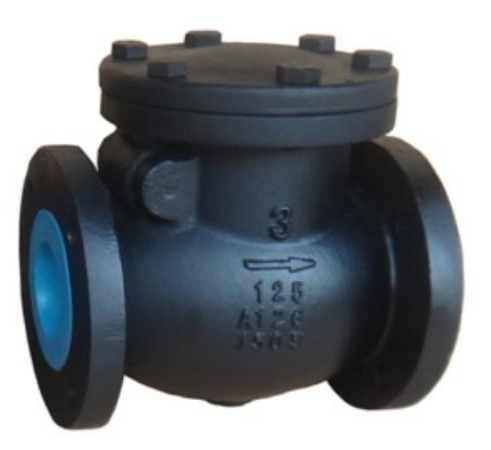
A reliable non-return valve designed in accordance with DIN standards, featuring a swinging disc that opens to allow forward flow and closes automatically to prevent backflow.
View Technical Specs
The ANSI Swing Check Valve is engineered to comply with ANSI/ASME B16.34 and API standards, delivering exceptional performance in high-pressure and high-temperature applications. Its simple yet effective design incorporates a hinged disc that swings open when fluid flows in the forward direction, allowing unobstructed passage, and closes automatically when flow reverses, preventing backflow and protecting critical system components.
Constructed from premium materials such as carbon steel, stainless steel, or alloy steel, the valve offers superior strength, corrosion resistance, and durability. The disc is typically made of stainless steel with resilient seating materials like PTFE, EPDM, or Stellite, ensuring tight shutoff even under challenging conditions.
With its flanged end connections designed to ANSI B16.5 standards, the valve is easy to install and maintain. It is widely used in oil and gas, chemical processing, power generation, water treatment, and other industrial sectors where reliable non-return functionality is essential.
A single hinged disc provides reliable closure, minimizing water hammer and ensuring bubble-tight shutoff even at low pressures.
Manufactured to meet ANSI/ASME B16.34 and API standards, ensuring compatibility with global industrial systems and regulatory requirements.
Capable of handling pressures up to Class 2500 and temperatures up to 650°C, making it suitable for severe service applications.
Available in a range of materials including stainless steel (304/316) and Hastelloy for compatibility with corrosive and abrasive media.
Simple construction allows for easy inspection and replacement of discs and seats without removing the valve from the pipeline.
Suitable for use in oil and gas, chemical processing, power generation, water treatment, and other industrial applications.
| Parameter | Specification Range |
|---|---|
| Nominal Diameter (NPS) | 1/2" ~ 48" (DN15 ~ DN1200) |
| Pressure Class | Class 150, 300, 600, 900, 1500, 2500 |
| Operating Temperature | -29°C ~ 650°C (Depending on material) |
| Applicable Media | Oil, Gas, Water, Steam, Chemicals, Slurries |
| Sealing Class | API 598 Class VI, ISO 5208 Class 1 |
| Component | Material Options | Standards/Features |
|---|---|---|
| Body | Carbon Steel, Stainless Steel, Alloy Steel | ASTM A216 WCB, ASTM A351 CF8/CF8M, ASTM A182 F11/F22 |
| Disc | Stainless Steel, Hastelloy, Monel | ASTM A182 F304/F316, Hastelloy C276, Monel 400 |
| Seat | Resilient Polymers, Metal | PTFE, EPDM, Viton, Stellite |
| Hinge Pin | Stainless Steel, Alloy Steel | ASTM A182 F304/F316, ASTM A182 F11 |
| End Connection | Flanged, Welded | ANSI B16.5, ANSI B16.25 |
The ANSI Swing Check Valve operates on a straightforward mechanism to control fluid flow and prevent backflow:
Used in upstream, midstream, and downstream oil and gas operations, including pipelines, refineries, and petrochemical plants.
Ideal for handling corrosive and aggressive chemicals in chemical plants, ensuring safe and reliable operation.
Suitable for use in thermal, nuclear, and renewable energy power plants, protecting turbines and other critical equipment.
Used in water treatment plants, distribution networks, and wastewater systems to prevent backflow and protect pumps.
Suitable for a wide range of industrial applications, including manufacturing, mining, and food processing.
Designed for use in marine and offshore applications, including ships, offshore platforms, and subsea systems.
A: ANSI swing check valves are designed to meet American National Standards Institute (ANSI) specifications, while DIN swing check valves comply with German Institute for Standardization (DIN) standards. ANSI valves typically have higher pressure ratings and are used in North American and international applications, while DIN valves are more common in European markets.
A: Yes, ANSI swing check valves can be used for cryogenic applications, but they must be made of materials suitable for low temperatures (e.g., stainless steel or nickel alloys). It is important to select the correct seat material (e.g., PTFE or metal) for the specific cryogenic service conditions.
A: The size of the valve should be based on the nominal pipe size (NPS) and the flow rate. It is also important to consider the pressure rating and temperature of the application to ensure the valve can handle the operating conditions.
A: ANSI swing check valves can be used for slurry applications, but they must be designed with features such as hardened discs and seats to withstand abrasion. It is also important to consider the flow velocity and solids content of the slurry to ensure proper valve performance.
A: ANSI swing check valves are designed to be installed in horizontal pipelines with the hinge pin in the horizontal position. They can also be installed in vertical pipelines with upward flow, but downward flow is not recommended as it may affect the closing performance.
Our engineering team can customize ANSI Swing Check Valves to meet your specific pressure, temperature, and media requirements. Contact us today for a personalized quote.
Contact Our Technical Team